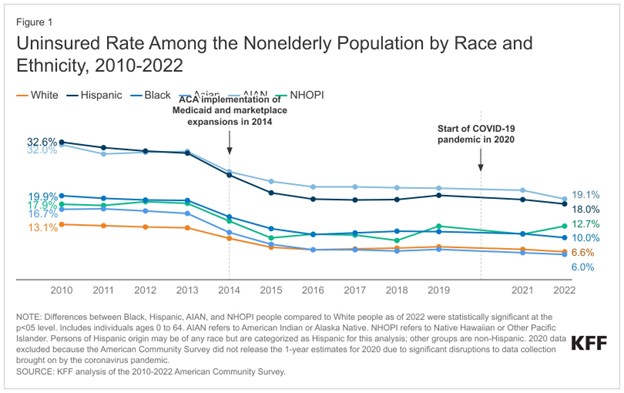
Medicaid has been a hot topic in previous elections – but is it in 2024? The previous blog in our series on health care and the 2024 elections discussed the Affordable Care Act (ACA) and the 2024 election. Today’s post will focus on Medicaid expansion and the 2024 election.
Medicaid Expansion Has Grown Steadily
The ACA authorized the expansion of the Medicaid program to include working-age adults without children or disabilities. Although the Supreme Court ruled against mandating expansion, the battles over this policy did not end. They only shifted to the states.
- 25 states and the District of Columbia (D.C.) implemented Medicaid expansion as soon as possible (January 1, 2014).
- Michigan and New Hampshire waited until later in 2014.
- Pennsylvania, Indiana, and Alaska joined the ranks of expansion states in 2015.
- Montana and Louisiana jumped on board in 2016, and Virginia and Maine implemented expansion in 2019.
- Idaho, Utah, and Nebraska joined the list in 2020. Oklahoma implemented expansion in 2021, and Missouri began processing applications that same year.
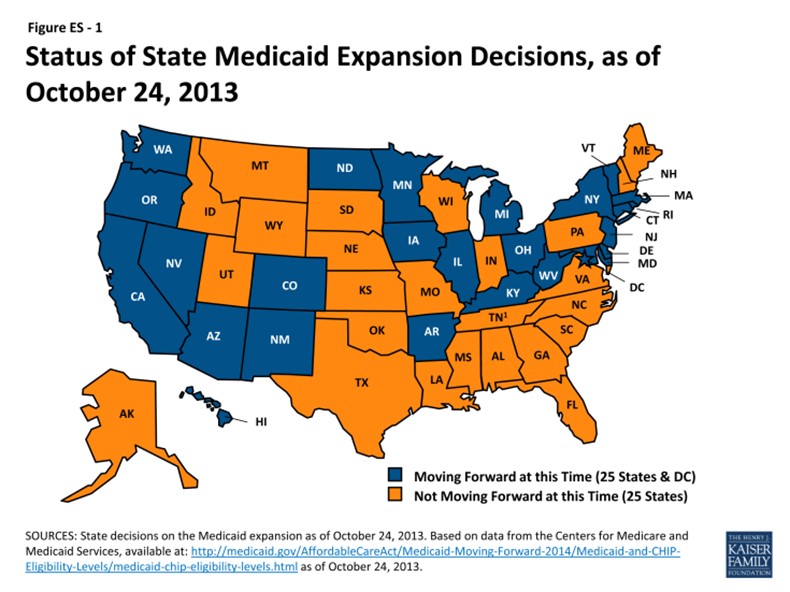
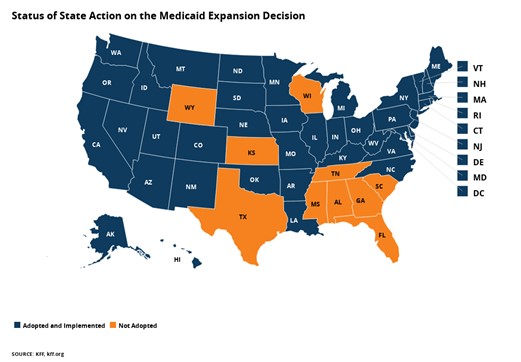
- South Dakota and North Carolina implemented expansion in 2023 and are the most recent editions to the list. You can see how the number of Medicaid expansion states has grown by comparing the two maps below from 2013 and 2023.
These 2 charts show you the change. Blue is yes to Medicaid expansion. Orange is no to Medicaid Expansion. See how the blue grows over the time period between 2013 and today.
Medicaid Expansion as of 2013: 25 States Plus DC
Medicaid Expansion in 2024: 35 States Plus DC
Big Growth, Big Political Implications
It’s worth noting that the growth in Medicaid expansion and the 2024 election intersect in a big way. As more states decide to expand Medicaid, the pathway to 270 electoral votes increasingly depends on appealing to voters who have gained health insurance coverage because of Medicaid expansion.
For example, let’s look at North Carolina. According to a press release from the North Carolina Department of Health and Human Services, more than 600,000 North Carolinians are now newly eligible for Medicaid coverage.
In 2020, North Carolina went for former President Trump, but his margin of victory was less than 100,000 votes. It begs the question of how many of these voters could flip to President Biden in 2024 and whether it could be enough to flip the state.
Even among more Trump-friendly states, the growth of Medicaid expansion could impact returns in 2024. For example, President Trump won 61.8% of the vote in South Dakota in 2020 with 261,043 votes compared to Biden’s 150,471. According to the U.S. Department of Health and Human Services, more than 52,000 South Dakotans can now enroll in Medicaid. Might more South Dakotans vote for Biden in 2024? Maybe. We don’t expect South Dakota, whose state government is redder than red to give Biden any votes in the electoral college. South Dakota has not voted for a Democratic presidential nominee since 1964. But post-election polling in November may provide some insight into how Medicaid expansion played into voters’ behavior this year.
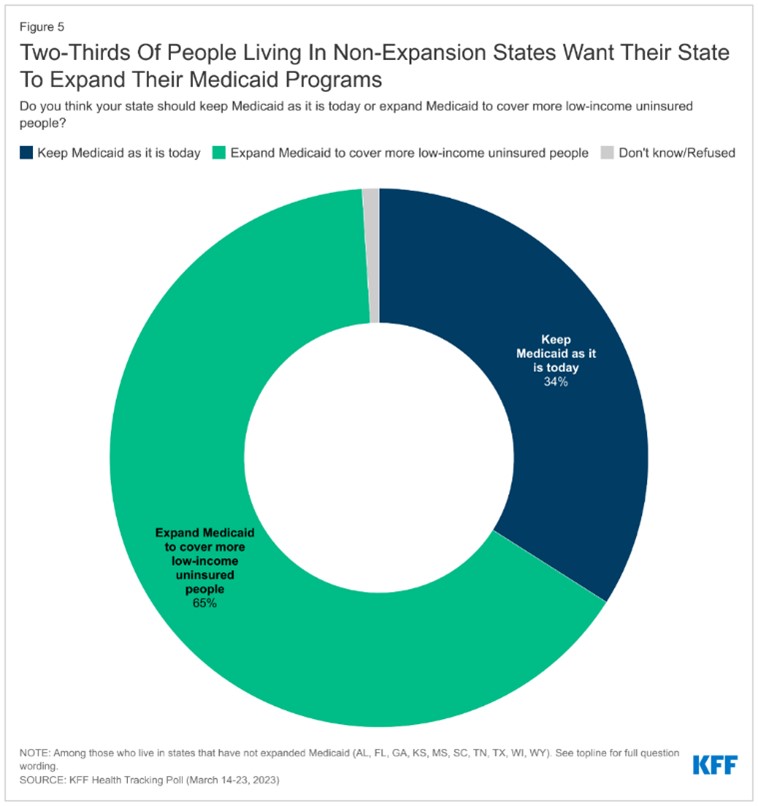
What, if any, implications are there in states that have not expanded Medicaid. Interestingly, the Kaiser Family Foundation conducted a poll in March 2023 showing that two-thirds of residents in non-expansion states are supportive of expansion.
Where Do the Candidates Stand?
Biden is Pro-Medicaid
- President Biden strongly supports the ACA, including the Medicaid expansion provision.
- The president included language in his proposed budget for fiscal year 2024 calling for “Medicaid-like coverage” for those who live in states that have not expanded Medicaid.
- The president’s budget proposal also called for “financial incentives to ensure states maintain their existing expansions.” President Biden’s decision to include these provisions in the proposal shows his strong support for getting all states to adopt Medicaid expansion.
- President Biden continues to highlight his record on protecting and expanding Medicaid in contrast to former President Trump.
Where is Trump on Medicaid?
- Meanwhile, Former President Trump has not yet talked much about Medicaid expansion in his 2024 campaign. However, we can look at his time in office to see what we might expect if he won reelection.
- In 2020, the Trump Administration offered a demonstration program they argued would provide more flexibility to states in providing benefits to working-age adults without disabilities. However, critics of the plan, such as Senator Tim Kaine (D-VA), charged that it threatened the health care of the Medicaid expansion population.
- The Trump Administration also supported allowing states to impose work requirements on the Medicaid expansion population. Vox Senior Correspondent Dylan Scott argued at the time that these policy changes were part of an effort to undo the expansion of Medicaid under the ACA.
Medicaid Expansion and the 2024 Elections
President Biden and former President Trump have a record regarding policies related to Medicaid expansion. As the list of Medicaid expansion states grows, so does the importance of how the leading presidential candidates talk about this issue. Ultimately, it will be up to the candidates to decide how much to talk about the issue of Medicaid expansion and what to say. And, of course, the American people have the final say. As Alexander Hamilton put it, “Here, sir, the people govern; here they act by their immediate representatives.”