Insights^

Find our analysis on legislation, regulations, MedPAC meetings, and more. 

How Restricting Could Determine Control of the House

With each new decade comes a new Census, and with every new Census comes a redrawing of the map of congressional districts for the House of Representatives.   Known as redistricting, the stakes of this process couldn’t be higher, with Democrats clinging to a narrow majority in the House and the electorate bitterly divided among voters of either party.  However, thanks to the pandemic and controversies from the redistricting process 10 years ago, the process to determine congressional district boundaries ahead of the 2022 midterm elections will look more complicated than usual.

How States Determine Congressional Districts

The lines for congressional districts are redrawn at the state-level every 10 years.  Notably, each congressional district is required to be as equal to the population in all other congressional districts in a state as practicable.  Using new census data, states typically determine district boundaries through one of three ways:

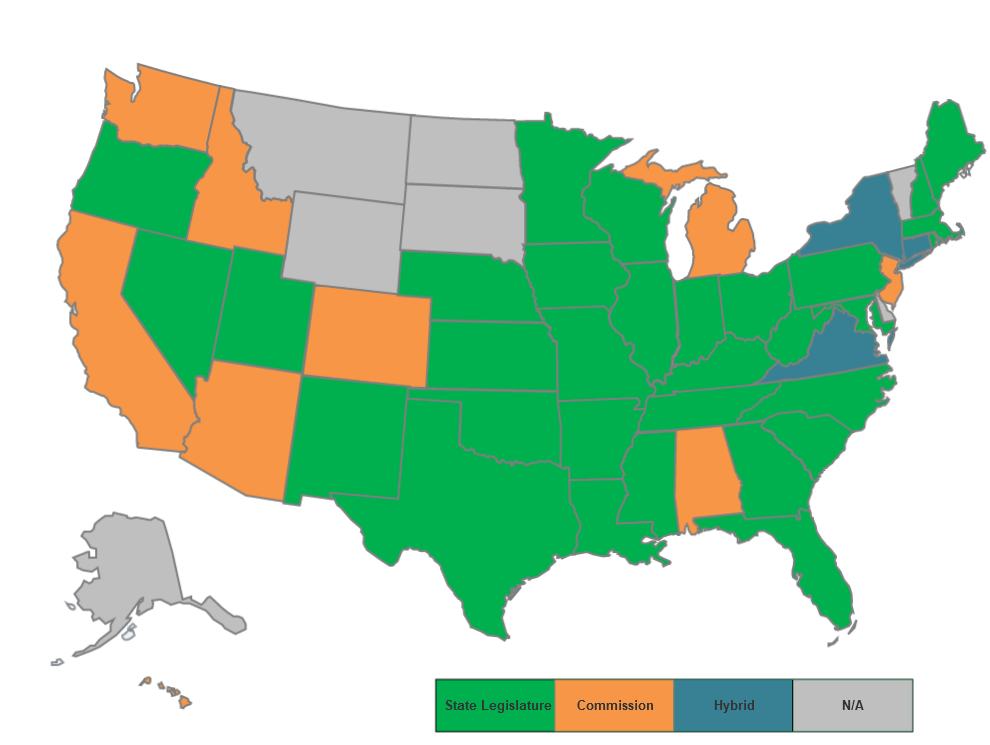
  1. State legislature.  The state legislature has ultimate authority to draft and implement maps for congressional districts.  While some states may have advisory commissions who assist with the redrawing process, state legislatures are not bound to follow the commissions’ recommendations.
  2. Commission.  An independent commission is tasked with drawing the boundaries of congressional districts.  Some commissions bar individuals that hold elective office from serving on them, while others may include elected officials.
  3. Hybrid.  Both a state legislature and a commission share redistricting authority.

Below is a map that shows each state’s redistricting process as of 2020.  Notably, states with only one member serving in the House of Representatives do not participate in the redistricting process.
States are tasked every decade with redrawing their congressional districts based on new census data.  With Democrats holding a five-seat majority in the House, how congressional maps are re-drawn could have a huge impact on which seats change hands and what party assumes the majority in the next Congress.  This blog post provides an overview of what the redistricting process will look like and what it means for the 2022 midterm elections in the House.

Since most states have their respective legislatures draw congressional boundaries, some state lawmakers feel an incentive to engage in partisan gerrymandering, which is when districts are drawn in a way that benefits their own party.  Related to this is racial gerrymandering, which refers to when districts are drawn to reduce the electoral power of one racial group in favor of another.  Notably, racial gerrymandering is prohibited under the Voting Rights Act of 1965.  While the Supreme Court ruled 5-4 in June 2019 that federal courts cannot weigh in on partisan gerrymandering cases, several lawsuits on the state level have been successful in changing maps.  In 2019, a three-judge panel in North Carolina threw out the Tar Heel state’s new congressional map for unconstitutional partisan gerrymandering, prompting a redrawing of the map that gave Democrats an edge.  One year earlier, Pennsylvania’s Supreme Court declared the commonwealth’s 2011 congressional districting map to be in violation of the Pennsylvania Constitution, leading the way to a new map that also left Republicans disadvantaged.

Delayed Census Data, Delayed Maps

Normally, the US Census Bureau releases its apportionment data in December of the year it is collected, with more in-depth demographic data that states use to determine district boundaries released throughout February and March of the following year.   However, COVID-19 delayed the Census Bureau’s ability to gather and process data, and therefore the apportionment data wasn’t posted until April 26, 2021, and the more in-depth data states use to draw district boundaries won’t be available until August 12.  The apportionment data refers to the number of seats in the House of Representatives allotted for a state based on the state’s population, while the more in-depth data includes demographic information such as age, sex, and race as well as geographic boundaries like jurisdictional limits, school districts, property lines, roads, and other features that states will use to redraw maps.

Due to the delay in receiving census data, states are facing tight deadlines on drawing their 2022 congressional maps.  Currently, 12 states are required either constitutionally or statutorily to have their 2022 congressional district boundaries enacted before the end of 2021.  As a result, many states are expected to hold special legislative sessions this fall to focus on redistricting.  Other states are using non-census data to draw new district boundaries.  For example, the state legislatures of Illinois and Oklahoma are both using data from the American Community Survey (ACS) to come up with new maps.  However, some dispute that ACS data can serve as a stand-in for census data, and the Illinois Republican Party has already filed a lawsuit to challenge the forthcoming new map.  By summer 2022, at least half of states are expected to have their new congressional districts finalized.

What to Watch for in 2022

Apportionment data released in April saw a dozen states either gain or lose House seats based on changes in total population.  Below is an overview of the states that will see changes in their delegation, with the current number of seats in the 117th Congress noted in parentheses.

  • States that will lose one seat: California (53), Illinois (18), Michigan (14), New York (27), Ohio (16), Pennsylvania (18), West Virginia (3).
  • States that will gain one seat: Colorado (7), Montana (1), North Carolina (1), Oregon (5).
  • States that will gain two seats: Florida (27), Texas (36).

Going into the 2022 redistricting process, Republicans have the upper hand.  A major reason for this is Democrats currently have a slim five-seat majority in the House, which means Republicans only have to flip a few seats to retake the majority.  Heading into 2022, two factors give the GOP an advantage when it comes to winning new seats.

  • Apportionment data.  Many of the states that are set to lose one seat are Democratic-leaning, while Republican-leaning Florida and Texas gain two seats apiece.  A minor shift in seats away from blue states toward red states could be especially impactful in the House.
  • Control of state legislatures.  The Republican Party holds a supermajority in the legislatures of 30 state governments, meaning party members control both the upper chamber and the lower chamber of a state’s legislative branch.  In contrast, Democrats hold a supermajority in 18 states, while control is split between the parties in two states’ legislature.  This translates to Republicans having direct control over the boundaries of 187 districts, while Democrats only control 75.  Out of the remaining districts, independent commissions will decide 96, both parties will decide 71, and six seats represent at-large districts.  By holding supermajorities in most state legislatures, the GOP is better positioned to engage in gerrymandering and redraw congressional lines in their favor.  Notably, the Republican Party controls the state legislatures of Texas and Florida, both of which will be gaining two seats for 2022.

However, Democrats have a few tricks up their sleeve to counter Republicans’ advantage in redrawing the congressional map.

  • Lawsuits. Litigation brought about changes in the congressional maps in Pennsylvania and North Carolina in recent years, and new legal challenges could open the door for more changes as redistricting for 2022 heats up.  The National Democratic Redistricting Committee, an advocacy organization founded by former US Attorney General Eric Holder, filed lawsuits in Louisiana, Minnesota, and Pennsylvania in April 2021, immediately following the release of the apportionment data.  As a worst-case-scenario for Republicans, some lawsuits could potentially overturn newly drawn maps, meaning some 2022 congressional races could be decided using the 2020 map.  It should be noted that Democrats are not the only party with a redistricting advocacy group, as the National Republican Redistricting Trust has pledged to challenge any maps that it sees as unfairly skewing to the left.
  • Democratic supermajorities.  State legislatures with Democratic supermajorities may attempt to redraw their lines through gerrymandering to squeeze out Republican members of the state’s congressional delegation, potentially providing a cushion for Democrats in anticipation of any 2022 losses in the House.  States to watch include Illinois and Maryland, where Democratic state lawmakers may redraw lines to make reelection a tough prospect for Reps. Rodney Davis (R-IL) and Andy Harris (R-MD).

Redistricting has massive ramification for US politics and this year is no exception.  Between delayed census data, tight redistricting deadlines, strong Republican advantages, and the specter of Democratic lawsuits, intense fights over the 2022 congressional map could be on the horizon.

US-map-1920x1280

What Happened, What You Missed: August 2-6

Moderna Becomes Second Vaccine Maker to Recommend Third Dose

On August 5, Moderna said a third dose of its COVID-19 vaccine will likely be necessary as a “booster shot” this winter as immunity gradually declines.  The company is currently testing three candidates that could be used as a third dose to boost immunity against rising COVID-19 variants such as Delta.  Moderna also announced that its vaccine is 93% effective six months after the second dose, even against the Delta variant.  Moderna’s calls for a third dose came one week after Pfizer released data that showed a third dose of its vaccine increased antibody levels against the Delta variant.   Amid growing interest in a third vaccine dose, the World Health Organization notably called for wealthy nations to hold off on distribution of third doses to their populations and instead focus on distribution to low-income countries where vaccination rates remain low.

HHS Inspector General to Review FDA’s Accelerated Approval Process

On August 4, the Department of Health and Human Services Office of the Inspector General (OIG) announced it will review the accelerated approval pathway used by the Food and Drug Administration (FDA) to review drugs that treat serious conditions and fill an unmet medical need.  The review was sparked by FDA’s use of the accelerated approval process for Alzheimer’s disease drug Aduhelm, which spurred scientific disputes within FDA as well as allegations of an “inappropriately close relationship” between FDA and the pharmaceutical industry.  Acting FDA Commissioner Janet Woodcock asked OIG to review the process used to approve Aduhelm in mid-July, and she has since pledged full cooperation with OIG’s pending investigation.

Vote on Infrastructure Bill Could Come This Weekend

Senate Majority Leader Chuck Schumer (D-NY) is hoping to hold a procedural vote to end the debate on a $550 billion bipartisan infrastructure bill as soon as Saturday after Senators failed to reach an agreement on Thursday night.  The Senate spent most of Thursday waiting for a Congressional Budget Office score that projected the measure will add $265 billion to the federal deficit over 10 years.  The Senate is out of session on Friday, and several Senators will be using their day-long break to attend the funeral of former Sen. Mike Enzi (R-WY).   If the Senate clears the bipartisan infrastructure bill when it reconvenes on Saturday, Senate Democrats will immediately pivot to working on a budget resolution with instructions for reconciliation that include the “human infrastructure” pieces.

Former Michigan Senator Carl Levin Has Died

Carl Levin, Michigan’s longest-serving US Senator, died on July 29 at age 87.  Elected to the Senate in 1979 after practicing law and serving on the Detroit City Council, Levin helped set military priorities as Chairman of the Armed Services Committee and investigated corporate behavior as Chairman of the Permanent Subcommittee on Investigations.  Throughout his six terms in the Senate, the liberal Michigan Democrat was known for his defense of Senate traditions and tenacity in uncovering corruption.  Levin hailed from a political family – his brother, former Rep. Sander Levin (D-MI), chaired the powerful House Ways and Means Committee, and his nephew, Rep. Andy Levin (D-MI), currently represents a district north of Detroit.

CMS Finalizes 2022 Payment Rates for Acute Care Hospitals

final rule issued by the Centers for Medicare and Medicaid Services (CMS) on August 2 provides for a 2.5% increase in hospital reimbursement rates under Medicare’s Inpatient Prospective Payment System (IPPS) for Fiscal Year (FY) 2022.  The rule also includes a $1.1 billion decease in disproportionate share hospital payments from FY 2021 and adds a Maternal Mortality measure to the hospital quality reporting program.  Furthermore, the final rule contains several provisions related to the COVID-19 public health emergency, namely a new requirement for hospitals to post vaccination rates among employees as well as authorization of additional payments for COVID-19 diagnostics and therapies.  The final rule goes into effect on October 1, 2021.

ICYMI: DC Area Athletes Rack Up Medals in Tokyo Olympics

So far in the 2020 Summer Olympics in Tokyo, US athletes who hail from the Washington, DC area have been winning big.  Maryland natives Katie Ledecky, Chase Kalisz, and Andrew Wilson have all won gold medals in swimming events, while Maryland triathlete Katie Zaferes has earned the silver and bronze medals in two separate triathlon events.  Additionally, Noah Lyles of Alexandria, Virginia won a bronze medal in the men’s 200-meter race, while Lucas Kozeniesky of Fairfax County Virginia narrowly missed a gold medal in the mixed 10m air rifle event.  Of note, several athletes hailing in the region are still competing in track, soccer, basketball, and wrestling events.

pexels-anna-shvets-3786166-scaled

Lay of the Land for 2022 Gubernatorial Races

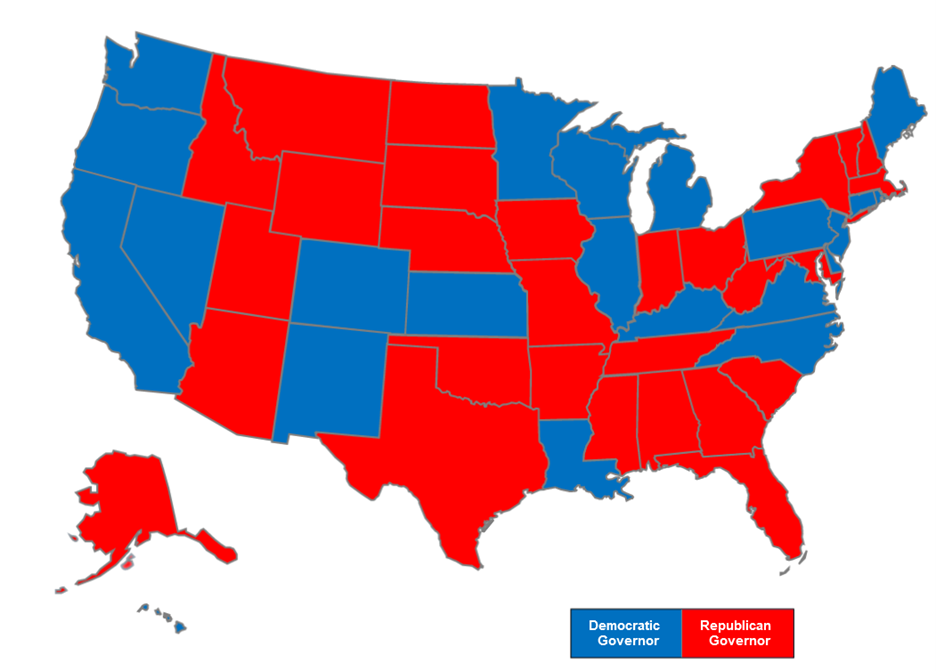
The 2022 midterms aren’t just about Congress.  36 states will be holding gubernatorial elections, and the consequences will not just determine state-level policies but also inform future political players on the federal level for presidential races..  At the moment, 27 states have Republican governors, while 23 have Democratic governors.

Nearly 40 state governorships are up for grabs over the next two years, and the winners of these races will have a broad impact on not just state-level policies but also the potential to reshape rising political stars on the national stage.  This blog post looks at all the upcoming gubernatorial races for 2021-2022 and provides insight on the likely outcome.

The 2021 Races

One indicator of the 2022 midterms will be three gubernatorial races scheduled in fall 2021.  Both New Jersey and Virginia have held their gubernatorial elections off-year to avoid being overshadowed by federal elections, while California’s election is part of a recall effort.

  • In New Jersey, incumbent Democratic Governor Phil Murphy is seeking a second term.  He will face Republican nominee and current State Assemblyman Jack Ciattarelli. The state gubernatorial election will take place on November 2, 2021.
  • In Virginia, former Governor Terry McAuliffe is seeking a second term in a November 2, 2021, where he will face off against Republican nominee Glenn Youngkin.  Unlike other state governors, Virginia governors are not allowed to serve consecutive terms, which is why the current Democratic Governor Ralph Northam is not seeking reelection.
  • In California, incumbent Democratic Governor Gavin Newsom faces a recall election on September 14, 2021.  46 candidates have been deemed qualified to appear on the ballot, including 9 Democrats and 23 Republicans.

However, the 2021 gubernatorial races are unlikely to serve as a bellwether for the 2022 midterms.  All three states are solidly Democratic, with Democrats currently serving as governor, attorney general, and secretary of state.  Additionally, the state legislatures of Virginia, New Jersey, and California all have Democratic majorities.

The 2022 Outlook

Of the 36 states in the mix for 2022, 20 governorships are held by Republicans, while 18 are held by Democrats.  Below is a chart of all states with 2022 gubernatorial elections, their likely outcome according to the Cook Political Report, and a comparison with 2020 presidential election results.

State Incumbent Party Projection 2020 Presidential Margin
Alabama Kay Ivey R Solid R Trump (+25.5)
Alaska Mike Dunleavy R Solid R Trump (+10.1)
Arizona Doug Ducey* R Toss-up Biden (+0.3)
Arkansas Asa Hutchinson* D Solid R Trump (+27.6)
California Gavin Newsom† D Likely D Biden (+29.5)
Colorado Jared Polis D Solid D Biden (+13.5)
Connecticut Ned Lamont D Solid D Biden (+20)
Florida Ron DeSantis R Lean R Trump (+3.4)
Georgia Brian Kemp R Lean R Biden (+0.2)
Hawaii David Ige* D Solid D Biden (+29.5)
Idaho Brad Little R Solid R Trump (+30.7)
Illinois J.B. Pritzker D Solid D Biden (+16.9)
Iowa Kim Reynolds R Likely R Trump (+8.2)
Kansas Laura Kelly D Toss-up Trump (+14.6)
Maine Janet Mills D Likely D Biden (+9.1)
Maryland Larry Hogan* R Lean D Biden (+33.2)
Massachusetts Charlie Baker R Solid R Biden (+33.5)
Michigan Gretchen Witmer D Lean D Biden (+2.4)
Minnesota Tim Walz D Likely D Biden (+7.1)
Nebraska Pete Ricketts* R Solid R Trump (+19.1)
Nevada Steve Sisolak D Likely D Biden (+2.4)
New Hampshire Chris Sununu R Likely R Biden (+7.4)
New Mexico Michelle Lujan Grisham D Solid D Biden (+10.8)
New York Andrew Cuomo D Solid D Biden (+23.1)
Ohio Mike DeWine R Likely R Trump (+8)
Oklahoma Kevin Stitt R Solid R  Trump (+33.1)
Oregon Kate Brown D Likely D Biden (+16.1)
Pennsylvania Tom Wolf* D Toss-up Biden (+1.2)
Rhode Island Daniel McKee D Solid D Biden (+23.1)
South Carolina Henry McMaster R Solid R Trump (+11.7)
South Dakota Kristi Noem R Solid R Trump (+26.2)
Tennessee Bill Lee R Solid R Trump (+23.2)
Texas Greg Abbott R Likely R Trump (+5.8)
Vermont Phil Scott R Solid R Biden (+35.4)
Wisconsin Tony Evers D Lean D Biden (+0.6)
Wyoming Mark Gordon R Solid R Trump (+43.3)

*Not eligible for reelection due to term limits

†Dependent on results of 2021 recall election

Democrats face an uphill battle in the 2022 gubernatorial races.  In 16 of the 19 midterm elections held since World War II, the party of the president lost bids for governorship.  However, 2022 is unlikely to see a lot of turnovers in the governors’ mansions due to the fact that all but six races feature incumbents, who generally face an advantage in retaining their seats.  Nonetheless, conditions could change for all gubernatorial candidates, depending on the popularity of President Joe Biden, the state of the economy, public health, and countless other measures.

element5-digital-ls8Kc0P9hAA-unsplash-scaled

ARPA-H, the Proposed Agency to Transform Biomedical Research

The internet.  GPS.  The computer mouse.  These are some of the technological innovations made possible by the Defense Advanced Research Projects Agency (DARPA), a Defense Department agency tasked with advancing research and development of science and technology programs.  Now, the Biden administration wants to replicate DARPA’s success in biomedical research with a newly proposed entity called Advanced Research Projects Agency for Health (ARPA-H).

What Is ARPA-H?

The Biden administration’s Fiscal Year (FY) 2022 budget request provided a $6.5 billion investment for APRA-H, which would be directed to drive “transformational innovation” in health research and speed application and implementation of health breakthroughs.  The initial focus of ARPA-H would be cancer, disabilities, and Alzheimer’s disease.  According to a concept paper provided by the White House, examples of projects that could be pursued by ARPA-H include:

  • mRNA vaccines to prevent most cancers.
  • Molecular “zip codes” that target drugs only to specific tissues and cell types, to eliminate serious side effects.
  • Highly accurate, inexpensive, wearable monitors for blood pressure and blood sugar that provide real-time data to patients and providers.
  • Holistic systems that eliminate racial disparities in maternal morbidity and mortality rates and premature births.
  • A process to design, test, and approve a vaccine against any newly emerging human virus in 100 days.

The National Institute of Health (NIH) further explains that ARPA-H will predominantly focus on “time-limited” projects with goals, metrics, and accountability.  It also states that the director of ARPA-H will be selected based on having a “proven innovation and partnership-building track-record,” and ARPA-H program managers will be recruited from industry, academia, or other sectors based on “scientific vision, judgement, and management skills. (Clonazepam) ”

ARPA-H is also included in the Cures 2.0 discussion draft that was released by Reps. Diana DeGette (D-CO) and Fred Upton (R-CO).  However, the discussion draft is still a work in progress, and it contains far fewer details on the proposed agency than those provided by the Biden administration.

How Would ARPA-H Advance Biomedical Research?

Ideally, ARPA-H would need many of the same authorities used by DARPA to accomplish its mission to delivery breakthroughs in biomedical research.  Key authorities would include:

  • The ability to hire individuals rapidly based on “a unique skill set” outside the typical civil services hiring system and pay those individuals a competitive wage, as well as the ability to recruit experienced program managers from the private sector.
  • Broad, flexible funding authority that make it possible to mix and match the best ideas with minimal bureaucracy that allow for projects that can be funded for multiple years or don’t necessarily fit into one-year intervals.
  • Exemptions from the traditional review process for biomedical research, which can take up to 18 months or longer, to get from an idea to a scientific review before the actual work begins.

According to a July 26 Federal News Network interview with NIH Director Francis Collins, an ARPA-H with “some new authorities” could make a difference for experimental drugs that show a lot promise during clinical trials but fail to attract investment from pharmaceutical companies due to an experimental products being perceived as too risky or having a limited market share.  In these cases, Collins explained ARPA-H could chose to invest in certain experimental drugs and hand them over to the private sector when necessary.

The Structure of APRA-H

The Biden administration has stipulated that ARPA-H would be a “distinct division” within NIH, with a “unique culture and organization.”  However, some medical experts have argued ARPA-H should be a stand-alone entity within the Department of Health and Human Services (HHS), including a former chair from DARPA’s advisory committee, who suggested NIH’s approach to research and innovation is too time-consuming and bureaucratic.  In response, Collins told The Washington Post in mid-June that putting ARPA-H outside of NIH would be a big mistake because it would lead to “administrative duplications” and preclude the chance for ARPA-H program managers to develop synergy with their colleagues at NIH.  While the Cures 2.0 discussion draft has yet to define ARPA-H’s structure and home, Collins has said that DeGette and Upton are leaning towards having the new agency withing NIH.

Collins also threw cold water on the notion that ARPA-H could create internal jealously within NIH in his Federal News Network interview by countering that many NIH employees are excited about the prospect of a new research agency and that “unfriendly competitiveness” exists in other parts of the government.  It’s worth noting that the administration’s FY 2022 budget request includes a major increase in NIH funding rather than diverting away funds to create a new agency.

Next Steps

APRA-H only becomes a reality when FY 2022 appropriations bills are signed into law, and the FY 2022 appropriations process has gotten off to a slow start.  The House passed an appropriations minibus for FY 2022 on July 31 that includes $3 billion for ARPA-H, while the Senate only began reviewing its FY 2022 spending proposals on August 2. , Notably, the proposals to create a new biomedical research agency been favorably viewed by members of both parties, meaning ARPA-H is unlikely to be cut from the legislation. However, given lawmakers’ slow progress on appropriations and long list of other items that require their attention in the next 60 days, all FY 2022 spending measures are unlikely to be finalized by the end of the FY 2021 on September 31.  This means NIH may not be able to take the first steps in building up ARPA-H until Congress finalizes the FY 2022 appropriations bills later in the fall or winter.

Once FY 2022 funding is squared away, Collins hopes to hit the ground running.  In his Federal News Network interview, the NIH director said he hopes to recruit 50-100 program managers for the agency’s first year, with results on research projects expected in the following one to two years as ARPA-H continues to “staff up and ramp up.”  Collins also projected to have 50-60 projects going at ARPA-H by the end of FY 2022, assuming all FY 2022 spending bills are enacted by December 2021.

pexels-pixabay-356040-1920x1280

What Happened, What You Missed: July 26-30

New CDC Guidance Say Vaccinated People Should Wear Masks Indoors

On July 27, the Centers for Disease Control and Prevention (CDC) issued updated guidance that advises fully vaccinated people to wear masks in “pubic, indoor settings” in counties with “substantial” or “high” levels of COVID-19 transmission.  The guidance also calls for all students, teachers, and staff at K-12 schools to wear masks, regardless of vaccination status.  CDC says it updated the guidance on masking in response to the high transmissibility of the Delta variant as well as new data that shows vaccinated people who catch COVID-19, but are asymptomatic, can spread the Delta variant just as easily as those who are unvaccinated.  Since the new guidance was released, several jurisdictions including Washington, DC and Chicago have issued new requirements for vaccinated individuals to wear masks when indoors.

Biden Announces New Vaccinations and Testing Requirements for Federal Workforce

On July 29, President Joe Biden announced new requirements for all civilian federal employees, onsite contractors, and military servicemembers to be vaccinated or otherwise face regular testing, masking, and social distancing requirements.  Biden first hinted at a vaccine mandate for federal workers on Tuesday following the CDC’s announcement on its new masking guidelines for vaccinated people. However before his announcement, on Monday the Department of Veterans Affairs announced it will require its frontline health care workers to be vaccinated within eight weeks.

Pfizer Says Vaccine Efficacy Wanes after 6 Months, Makes Case for Third Dose

On July 28, Pfizer released a new study that showed the overall effectiveness of its two-dose COVID-19 vaccine declined from 96% to 84% after six months.  Pfizer separately released data on Wednesday that found a third dose of its vaccine increases antibody levels against the Delta variant by nearly five times for people ages 18 to 55 and more than 11 times among people 65 to 85.  However, it remains unclear if higher antibody levels actually lead to better protection, and the CDC has stated that currently approved vaccines provide adequate protection against the Delta variant.  Pfizer also announced that it plans to seek emergency authorization use under the Food and Drug Administration for a third dose sometime in August.

Senators Reach Agreement on $550 Billion Infrastructure Package

On July 27, a bipartisan group of Senators reached agreement on a $550 billion infrastructure bill that would provide $550 billion in new spending for roads, bridges, rail transit, clean water, broadband internet, airports, and environmental clean-up.  The bill would be partially paid for by repurposing COVID-19 relief funds and delaying implementation of the Medicare Part D drug rebate rule.  Next, the Senate is expected to hold a vote on Friday and work through the weekend.  Progress on the bipartisan infrastructure bill means Democrats can now  move on and focus solely on their $3.5 trillion human infrastructure bill that they intend to pass through budget reconciliation.

Former WY Sen. Mike Enzi Dies after Bicycle Accident

Former Wyoming Republican Senator Mike Enzi died on July 26 at age 77 due to injuries sustained from a bicycle accident just days before.  Enzi served as the Mayor of Gillette, WY and as a State Lawmaker before being elected to the Senate in 1996, where he would go on to serve four terms before retiring in 2020.  Known as one of the more conservative members of his party, Enzi served as Chairman of the Senate Budget Committee and Senate Health, Education, Labor and Pensions Committee.

ICYMI: Athletes from the Nation’s Capital Shine in 2020 Olympics

Aside from being home to our nation’s capital, the Washington, DC area is home to nearly a dozen members of the US Olympic Team who are currently competing in the 2020 Summer Olympics in Tokyo, Japan.  Probably the most well-known is 24-year-old swimmer Katie Ledecky, a Bethesda, MD native who won a gold medal in the 1500-meter freestyle  plus two silver medals in different swimming events.  Ledecky is joined on the 2020 US Olympic Swim Team by two other area natives – Torrie Huske of Arlington, VA and Phoebe Bacon of Chevy Chase, MD. (https://whyinstitute.com/)   Other Team USA athletes include several basketball players from the Washington Wizards and Washington Mystics, as well as two members of the women’s soccer team, Washington Spirit.

waldemar-brandt-Jd0vRxfpte4-unsplash-1920x1500

Subscribe to Us Now!

Be a DC insider by getting our updates straight to your inbox