Insights^

Find our analysis on legislation, regulations, MedPAC meetings, and more. 

All About Executive Orders

A hallmark of President Joe Biden’s first 100 days in office were 52 executive orders aimed at reversing the previous Administration’s actions and addressing the COVID-19 pandemic.   In comparison, Donald Trump had issued 39 executive orders in his first 100 days, while Barack Obama and George W. Bush respectively clocked in at 34 and 13.  Given this trend for new Administrations to issue more and more executive orders, it’s no surprise why people are asking just what executive orders are and why they matter.

What Is an Executive Order?

An executive order is an official, legally binding mandate passed down from the President to agencies under the executive branch that gives agencies instructions on how to interpret and carry out federal law.  Executive orders are printed and numbered consecutively in the Federal Register, alongside other federal regulatory actions.  Additionally, executive orders have the force and effective of law, so as long as the order is based on power vested in the President by the US Constitution or delegated to the President by Congress.

While the Constitution does not contain the term “executive order,” it does provide broad authority for the President to issue executive directives.  This authority derives from the “vesting clause” of the Constitution, which grants the President “executive power,” which has come to refer to the administrative actions of running the federal government.

Notably, executive orders are not legislation, and they do not require approval from Congress.  However, Congress may pass legislation that might make it difficult, or even impossible, to carry out the order, such as removing funding necessary to implement the order.  Congress can also pass legislation to override an executive order, although this legislation would be subject to a presidential veto.  Only a sitting US President has the authority to overturn an existing executive order by issuing another executive order.

Important Examples of Executive Orders

Many impactful executive orders have been issued of the years – here are a handful of them:

  • Abraham Lincoln suspended the writ of habeas corpus during the Civil War via executive order in 1861.  Lincoln cited his authority to issue the executive order under the powers under the Constitution’s Suspension Clause, which states, “the privilege of the writ of habeas corpus shall not be suspended, unless when in cases of rebellion and invasion the public safety may require it.”  Later, Lincoln issued two executive orders that comprised the Emancipation Proclamation, which he justified under wartime powers.
  • Franklin Roosevelt established internment camps during World War II via an executive order.  He also used an executive order to create the Works Progress Administration.
  • Harry Truman signed an executive order in 1948 to end segregation in the armed forces.
  • Dwight Eisenhower used an executive order to put the Arkansas National Guard under federal control and to enforce desegregation in Little Rock, Arkansas in 1957.

Biden’s Executive Orders on Health Care to Date

President Biden’s executive orders so far have focused on the COVID-19 pandemic, including creating a response coordinator and requiring masks in airports.  Additionally, he established an additional special enrollment period via healthcare.gov, and set up a health equity task force to address the needs of communities of colors and underserved populations.

So, Do Executive Orders Really Matter?

The answer is…it depends.  Historically, most executive orders have been for administrative purposes, such as requesting reports or forming task forces.  Beyond that, the impact of an executive order is limited to both the power of the President and the law.  For instance, President Donald Trump’s executive order to construct a border wall along the US southern border was technically meaningless because only Congress has the power to appropriate funds for border wall construction.

In practice, however, the impact of executive orders can be profound.  Even if executive orders do not change federal law, they serve as indicators of how the Executive Branch can be reshaped to carry out federal law in a way that reflects an Administration’s priorities.  While the Trump Administration’s executive order on the border wall did not immediately spark new construction on the southern border, it did represent a shift in how the executive branch carries out immigration law that Biden Administration has had a tough time reversing.  For instance, many federal agencies began to view legal immigration as something to restrict, contributing to a slowdown in legal immigration and changes personnel policies within relevant agencies.


pexels-pixabay-261621-scaled-1-1920x1440

Should Payment Parity for Telehealth Continue?

In response to the COVID-19 pandemic, the Centers for Medicare and Medicaid Services issued rulemaking to require Medicare to pay the same rates for telehealth and in-person care for the duration of the public health emergency (PHE).  Now that the end of the pandemic may be in sight, stakeholders are debating whether Medicare should continue offering payment parity for telehealth services post-pandemic.  Since Medicare’s actions often inform what private payers do, stakeholders will be watching closely what the agency decides to do.

Against Payment Parity

chief argument against payment parity is that it could lead to overutilization and higher spending.  For patients with the right technology, accessing telehealth can be very convenient, leading health experts to suggest some patients may use telehealth more than necessary.  Corollary to this, some experts are worried about telehealth’s potential to create more opportunities for waste, fraud, and abuse.

Additionally, opponents to payment parity contend that telehealth requires fewer resources and less clinical effort than in-person visits.  For example, a 2017 study from Health Affairs found the average cost of a telehealth visit for an acute respiratory infection was $79 compared to $146 for in-person visits.  Simple virtual check-ins may also require less decision-making, time, and other factors considered “clinical effort” when compared to in-person appointments.

Furthermore, some worry payment parity in telehealth may propagate low-value care.  For certain conditions, telehealth may prove limiting for providers, and there is no substitute for the type of evaluation physicians can provide through in-person visits.  Parity opponents argue that higher reimbursement rates tied to in-person visits will ensure patients can more regularly receive a full evaluation, thus preventing the likelihood symptoms missed during telehealth visits progress to become more expensive chronic conditions down the road.

For Payment Parity

Those in favor of continuing payment parity post PHE say there is no evidence that telehealth has resulted in overutilization.  Most instances of telehealth usage, parity proponents say, has been to substitute in-person to visits as a result of the COVID-19 pandemic.  According to data from electronic health record company Epic, the number of telehealth visits declined rapidly by summer 2020 following an initial increase in April 2020.  This data suggests that patients are so far not opting for more telehealth visits over in-person visits out of ease or convenience.  Additionally, some physicians argue some diagnoses can require as much clinical effort as in-person visits.  According to a 2020 study from the University of Michigan, surgeons reported spending more time on telehealth than in-person visits.

Proponents of payment parity also say telehealth services utilize far more resources than patients realize.  While telehealth may not seem to require the same “brick and mortar costs” as in-person visits, providers assert that telehealth requires an investment in technology, both to set-up virtual visits and keep up with changes in technology.  For certain medical conditions, digital monitoring and home-based care products may require additional resources.  Providers also say that some diagnoses can involve just as must clinical effort as do in-person appointments.

Moreover, parity supporters contend that clinical guidelines about when telehealth and in-person care is appropriate can prevent low-value care.  For instance, the American College of Obstetricians and Gynecologists has issued guidance on when patients should require a physical examination.

What Happens Next?

CMS can continue to pay the same rates or the agency could propose a differential payment rate.  Either way, the decision would be subject to the rulemaking with notice and comment.  For the part of Congress, the legislative branch hasn’t weighed in.  While legislators have introduced a slew of bills to permanently expand telehealth coverage and abolish pre-pandemic restrictions on telehealth, none address how telehealth should be paid for.  A lone exception is H.R. 8308, the Telehealth Coverage and Payment Parity Act.  Introduced by Rep. Dean Phillips (D-MN) in September 2020, the legislation would require commercial insurers to pay the same level for the same level for telehealth services as it would for in-person services.  However, this legislation does not affect Medicare, and as of this writing, the bill has yet to be reintroduced in the 118th Congress.

In their January 2021 public meeting, the members of the Medicare Payment Advisory Commission (MedPAC) suggested that Medicare continue telehealth payment parity for 1-2 years following the end of the PHE as a “pilot program” to evaluate how to telehealth services should be reimbursed permanently.  However, MedPAC’s comments have yet to be taken up in any legislative proposal.

pexels-anna-shvets-4225920-scaled-1-1920x1280

The Week in Review: May 17-21

Pfizer, Moderna CEOs Say Booster COVID-19 Shots May Be Needed       

During a May 19 virtual event hosted by Axios, the CEOs of Pfizer and Moderna said some Americans may need a COVID-19 booster shot within 8-12 months from the original vaccination.  While it is unknown how long protection from COVID-19 vaccines lasts, NIAID Director Anthony Fauci commented during the same event that immunity against most coronaviruses “is generally not lifelong.”  However, some experts say the rhetoric from Pfizer and Moderna on booster shots may be tied to business goals, and they stress there is no evidence that shows immunity from COVID-19 vaccines has declined.

Emergent BioSolutions CEO Says J&J Vaccine Production Could Restart Soon

The CEO of Emergent BioSolutions told the House Coronavirus Crisis Subcommittee on May 19 that production of the Johnson & Johnson COVID-19 vaccine could resume within days.  The Food and Drug Administration (FDA) ordered Emergent BioSolutions to halt production of the vaccine in April after FDA inspectors found overcrowding and unsanitary conditions at the biopharmaceutical company’s Baltimore facility.  Just a week before FDA ordered the pause, Emergent BioSolutions was forced to toss out 15 million J&J vaccine doses after the company had accidentally mixed J&J ingredients with those used for AstraZeneca’s COVID-19 vaccine.

Mask Guidance Partially Relaxed in Congress

Recently, the Office of the Attending Physicians issued new guidance saying fully vaccinated individuals in House Office Buildings are no longer required to wear masks and maintain social distancing.  The new guidance also lifted its maximum telework recommendation, meaning individual House offices can begin bringing remote staff back to the Hill.  Despite the new guidance, Speaker Nancy Pelosi (D-CA) has said the mask mandate on the House floor will remain in effect until all members have been vaccinated.  In response, some Republican members have been pushing the Speaker to drop all mask requirements. (jensen-jensen.com)   On  May 14, 34 House Republicans sent a letter to Pelosi urging her to waive all mask rules, and on May 19, nearly a dozen Republican lawmakers were fined for not wearing masks on the House floor.  Senate Majority Leader Chuck Schumer (D-NY) has yet to officially weigh in on changes to mask guidelines for the Senate floor, where members of both parties have recently been spotted without masks.

Top CDC Officials Step Down

On May 17, Centers for Disease Control and Prevention (CDC) Principal Deputy Director Anne Schuchat announced she plans to retire in the summer.  Schuchat, the CDC’s second highest-ranking official since 2015, has spent over 30 years at the agency.  Schuchat’s retirement announcement follows the early May resignation announcement of Nancy Messonnier, Director of CDC’s National Center for Immunization and Respiratory Diseases.  Messonnier had spent 20 years at the CDC and most recently led the agency’s COVID-19 task force.  While Schuchat and Messonnier have not specifically commented on their reasons for leaving CDC, reports suggest tension between the two and CDC Director Rochelle Walensky may have been a factor.  The high-level departures follow over a year of scrutiny of the CDC and its approach to issuing COVID-19 guidelines.

ICYMI: New Mask Policy for Nationals Park, DC Bars in Effect May 21

Starting on May 21, fully vaccinated individuals are no longer required to wear a mask while visiting Nationals Parks or going to a bar or restaurant in Washington, DC.  Additionally, bars and restaurants in the District are once again permitted to offer bar service to customers and allow customers to stand in common areas.  However, bars and restaurants still have the option of requiring guests to wear a mask when not eating or drinking.

pexels-rfstudio-3825529-scaled-1-1920x1371

Will Momentum on Maternal Health Legislation Continue?

The state of maternal health is quite bleak in the US, where women are more likely to die from childbirth or pregnancy-related causes than their counterparts in other developed countries.  After years of advocacy, legislation was enacted that allows states to extend post-partum health care coverage.  Could this mean more legislative proposals on maternal health could be enacted soon?

Pregnancy Crisis

There are significant maternal health disparities in the US, as black and Native Americans women are about three times more likely to die from pregnancy-related causes than white women.  The COVID-19 pandemic has further exacerbated the nation’s maternal health crisis by negatively impacting social determinants of health, reducing access to care, and straining social support networks.

Medicaid Postpartum Coverage

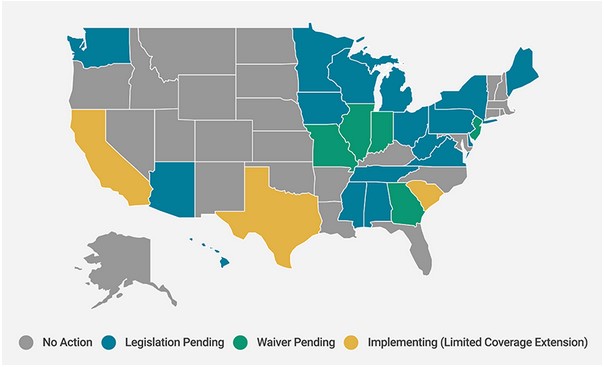
Signed into law on March 11, 2021, the American Rescue Plan Act gives states the option to extend Medicaid postpartum coverage from 60 days to 12 months.  Under this new coverage option, participating states must provide full Medicaid benefits both during pregnancy and the extended post-partum period.  However, questions remain about the potential impact of the new coverage option, which does not go into effect until April 1, 2022 and only lasts for five years.  For instance, it is not known how many states will elect the postpartum coverage option, particularly those that have expanded Medicaid coverage.  The impact of the law in non-expansion states remains uncertain, as well.

Status of State Efforts to Expand Postpartum Coverage Beyond 60 Days

Source: Health Affairs

Mommy Bills in the Hopper

Additional efforts to bolster maternal health are underway in Congress.  Key legislation introduced so far includes:

  • The Maternal Health Momnibus Act (S. 346/H.R. 959).  This bill would promote maternal vaccinations, encourage innovative payment models to support high-quality maternal care, and improve data collection to better understand the drivers of poor maternal health.

MOMMA’s Act (S. 916/H.R. 1897).  This legislation would expand Medicaid and CHIP benefits for pregnant women to include oral health services, give states the option to extend SNAP benefits to women for two years postpartum, and establish Centers of Excellence on cultural competency training for health care providers.

  • The Maternal Health Quality Improvement Act (H.R. 4995).  This bill would require the Health Resources and Services Administration to establish programs aimed at improving maternal health care in rural areas, including physician training grant programs and grants for networks that can increase access and coordinate care for pregnant women.  The bill advanced in the House but failed to be enacted.

For his part, President Biden’s American Families Plan, while centered around childcare, education, and paid leave, will “invest in maternal health” according to a fact sheet.  The American Families Plan could ultimately provide a legislative vehicle, to enact maternal health proposals, much like the Medicaid postpartum coverage bill was attached to the American Rescue Plan.

pexels-mart-production-7088526-scaled-1

The Week in Review: May 10-14

CDC: Vaccinated Americans Do Not Need to Wear Masks Indoors, Outdoors          

On May 13, the CDC announced people fully vaccinated against COVID-19 do not need to wear masks indoors or outdoors.  However, the CDC still recommends individuals continue to wear masks while in large crowds or while riding in planes, trains, or buses.  The update comes as US virus cases reach their lowest rate since September 2020 and COVID-19 deaths reach their lowest point since April 2020.  However, some warn the new guidance is likely to cause confusion, as there is no simple way for businesses or others to determine an individual’s vaccination status.

House GOP Replaces Cheney with Stefanik as Conference Chair

Republican members of the House of Representatives voted to remove Rep. Liz Cheney (R-WY) from her role as House Republican Conference on May 12 in a closed-door meeting.  The effort to remove Cheney from her House leadership role follows the Wyoming Congresswoman’s public criticism over former President Donald Trump.  On May 14, House Republicans voted to install Rep. Elise Stefanik (R-NY) as Cheney’s successor. While Stefanik has the backing of former President Trump, House Republican Leader Kevin McCarthy (R-CA), and House Republican Whip Steve Scalise (R-LA), some Republican members including Rep. Chip Roy (R-TX) have raised concerns over Stefanik’s moderate voting record.

Over 100 Republicans Threaten to Form Rival Party

Over 100 former Republican officials issued a joint statement on May 13 threatening to create an alternative party if current GOP elected officials continue to espouse falsehoods about the 2020 General Election.  Among the influential Republicans to sign the letter are former Republican National Committee Chairman Michael Steele, former Pennsylvania Governor Tom Ridge, and former Virginia Congresswoman Barbara Comstock.  The statement also outlines 13 core principles based on preserving democracy, supporting market-based economics, and maintaining ethical governance.

Nominations for HHS Deputy Secretary, CMS Administrator Advance

On May 11, the confirmed 61-37 Andrea Joan Palm to serve as Deputy of Health and Human Services.  Palm previously served as Deputy Assistant Secretary of Health and Human Services under the Obama Administration and had most recently served as Secretary of the Wisconsin Department of Health Services.  Two days later, the Senate voted 51-48 to advance the nomination of Chiquita Brooks-LaSure to serve as Administrator of the Centers for Medicare and Medicaid Services.  Brooks-LaSure’s nomination was previously stalled due to a hold from Sen. John Cornyn (R-TX) in protest of the Biden Administration’s decision to rescind Texas’s Section 1115 Medicaid waiver.  The procedural vote to advance Brooks-LaSure’s nomination indicates she is likely to be confirmed soon.  Notably, Sens. Jerry Moran (R-KS) and Susan Collins (R-ME) joined Democrats in the vote to bring Brooks-LaSure’s nomination to the floor.

ICYMI: Jurisdictions Use Cash, Beer to Urge Vaccinations

Ohio Governor Mike DeWine (R) announced the state will give away $1 million each to five vaccinated Ohio residents as a way to entice more Ohioans to get vaccinated.  DeWine’s announcement comes as state and local governments are creating incentives to encourage more people to get their shots.  In Washington, DC, for instance, individuals who received a Johnson & Johnson vaccine at the Kennedy Center on May 4 were offered a free beer.  Additionally, West Virginia began offering a $100 savings bond for state residents aged 16-35 who receive a vaccine shot.

pexels-anna-shvets-3902883-scaled-1

Subscribe to Us Now!

Be a DC insider by getting our updates straight to your inbox