


What do President Barack Obama, former Virginia Governor Glenn Youngkin, and former military personnel and Veterans have in common?
No, that’s not the punchline for a bar joke in the DC metro area – but it is about a brawl going on in the DMV. It’s about redistricting.
What’s Going on in Virginia?
Virginians are currently voting on whether to amend their state constitution to allow for mid-decade redistricting. If the amendment passes, the General Assembly will be granted the power to conduct mid-decade redistricting through 2030, a process normally handled by an independent commission. The effect would be a new Congressional election map more favorable to Democratic candidates for November.
Remind Me Again about Redistricting
Redistricting is the process of redrawing congressional district boundaries, which typically occurs every 10 years after the decennial census. However, there are exceptions to this. Courts may order a state to redistrict on the grounds that a map violates state or federal law. States have also, on rare occasions, engaged in mid-decade redistricting, if allowed, for partisan gain.
Don’t Mess with Texas
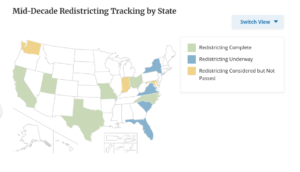
The current mid-decade redistricting fight began in the summer of 2025 when the Texas legislature instated a new map to create additional GOP seats. In response, California held a special election to approve a new map to create additional Democratic seats. Many states have gotten involved since. As of March 3, 2026, 6 states have implemented new maps, 4 have introduced legislation, and 4 are waiting on court orders.
What is Virginia Trying to Do?
The proposed constitutional amendment would give the Virginia General Assembly the temporary authority to redraw congressional districts if another state redraws its districts for reasons other than completing decennial redistricting or complying with a court order. Since actions in Texas and other states have already triggered this “if” scenario, the results of the April 21 vote would have immediate impact.
The Old Dominion with New Lines
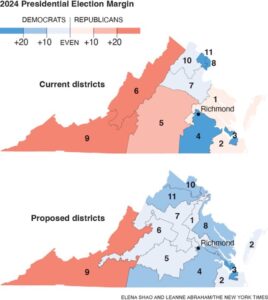
Democratic leaders proposed a new map that passed the General Assembly and approved by Governor Abigail Spanberger. That map would reduce the current 5 majority-Republican districts to 1, meaning Representatives Rob Whittman, Jen Kiggans, John McGuire, and Ben Cline would be in danger of not being reelected. Rep. Morgan Griffith’s district would essentially remain the same.
Virginia Isn’t Feeling Like It’s for Lovers Right Now
Virginians can’t drive, watch TV, or pick-up their mail without being reminded of this high-stakes vote. Democrats claim the amendment is a justified response to Republican interference with congressional maps in other states. Former President Barack Obama has appeared in ads advocating for the new map, saying he believes this could help level the playing field between Republicans and Democrats.
On the contrary, Republicans condemn how the change will decrease Republican representation in Congress and could undermine the power of rural votes. The proposed lines expand the current rural districts to include urban centers that tend to vote blue, which would over-power the voice of red-leaning rural voters.
Does Money Talk?
So far, the Democratic-led Virginia for Fair Elections has out-raised the Republican-led Virginia for Fair Maps $64 million to $20 million. The vote is expected to be close, but Democrats currently hold the edge according to polling from the Washington Post and George Mason University which found 53 percent of registered VA voters plan to vote for the amendment and 44 percent said they plan to vote against the amendment.
What Are the Implications for 2026?
With a razor-thin majority in the US House, Virginia has clear and direct implications for the balance of power.
Specific to health care, Rep. Kiggans currently serves on the VA Health Subcommittee, Rep. McGuire is a member of the Oversight Health Care Subcommittee, and Rep. Cline is on the Appropriations subcommittee with a focus on the FDA. Rep. Griffith’s position as the lead Republican on the House Energy and Commerce Health subcommittee would likely not be in jeopardy.
Looking Ahead
Without a Republican House, President Trump will likely spend the last two years of his term fighting subpoenas and impeachment votes. A more partisan 2027 and 2028 (is that even possible?) could impact the mood of voters in the 2028 election. Although President Trump will no longer be on the ballot, his popularity and legacy will weigh on the minds of Republican primary voters and the general election voters.