Insights^

Find our analysis on legislation, regulations, MedPAC meetings, and more. 

What Happened, What You Missed: September 6-10

Biden Announces Sweeping Vaccination Mandate for Health Care Workers

On September 9, President Joe Biden announced plans to mandate vaccinations for all health care workers at facilities that receive federal funding.  The announcement was a major component of a six-part planned aimed at addressing a nationwide surge in COVID-19 cases.   The vaccination mandate for health care workers is an extension of last month’s announcement on vaccination requirements for nursing home employees.  Biden also announced plans to require all federal employees to get vaccinated and require employers with 100 or more employees to mandate COVID-19 vaccines.  He further urged schools to use previously allocated funding to expand COVID-19 testing and called for an international summit on the global response to the COVID-19 pandemic.

HHS Releases Report on Proposals to Address High Drug Prices

On September 9, the Department of Health and Human Services (HHS) released a comprehensive plan to reduce drug prices in response to a July 9  Executive Order on Promoting Competition in the American Economy.  The report was initially released to members of Congress on August 23 but not made public until yesterday.  Among the report’s chief proposals is allowing the HHS secretary to negotiate Medicare Part B and Part D drug prices directly with pharmaceutical manufacturers and make those prices available to other purchasers.  The report also calls for promoting biosimilars and generics to foster competition and a cap on catastrophic spending under Part D.  Many of the report’s recommendations have already been included in Democrats’ $3.5 trillion Build Back Better Act.

Speaker Pelosi Rebuffs Calls to “Pause” $3.5T Infrastructure Bill

Despite calls from Sen. Joe Machin (D-WV) to take a “strategic pause” to rework the $3.5 trillion “human” infrastructure bill, House Speaker Nancy Pelosi (D-CA) supported House members to continue holding hearings to mark up the legislative text this week. Both Manchin and his moderate Democratic colleague Sen. Kyrsten Sinema (D-AZ) have stated that they will not support a $3.5 trillion bill, with Manchin specifying he won’t back more than $1.5 trillion in spending.  During the week, the Education and Labor; Science, Space, and Technology; Small Business; Veterans Affairs; and Ways and Means committees have already marked up portions of the reconciliation bill relevant to their jurisdiction.

SCOTUS to Return to In-Person Arguments in October

On September 9, the Supreme Court announced it will return to hearing oral arguments in the court building starting next month.  Since May 2020, the Supreme Court has been holding oral arguments exclusively by telephone. The court building will remain closed to the public and access to the courtroom will be limited to the Justices, certain Supreme Court personnel, and journalists with press credentials.  However, live audio feeds for those unable to sit in the courtroom will continue

ICYMI: Fencing Returns to US Capitol

Metal fencing will be reinstalled around the US Capitol as a security precaution ahead of a planned rally on September 18.  The rally is expected to feature far-right activists protesting the treatment of those arrested in connection with the January riot at the US Capitol.  Fencing was initially erected around the US Capitol immediately following the January 6 riot before finally being removed in July.  To prepare for the rally, Speaker Nancy Pelosi (D-CA) has been holding briefings with congressional leadership on security preparations. However, the US Capitol Police has so far decline to comment on or confirm the fencing and other security measures.


artur-tumasjan-qLzWvcQq-V8-unsplash-1920x1280

What Does Health Care Rulemaking Look Like This Year?

Even Congress tries to complete $4.5T in domestic policy changes plus appropriations in the next 3 months, the Biden Administration is cranking away on health care rulemaking.  Here’s a quick overview of some key rules on the horizon from the Department of Health and Human Services (HHS).

Go deeper:  Refresh your memory on OMB and rulemaking here.

Below are the health care rules currently under review at www.reginfo.gov.  At the moment, the public is unable to comment on the any of the rules listed until their publication in the Federal Register.

Title Category Type Status
Streamlining HHS
Guidance Practices
Internal HHS Policy Proposed Rule Received at OMB on
6/28/21
Reporting Requirements Related to Air
Ambulance and Agent
and Broker Services and HHS Enforcement
Provisions
Insurance Proposed Rule Received at OMB on
7/7/21
Establishing
Over-the-Counter
Hearing Aids and
Aligning Other
Regulations
Medical Devices Proposed Rule Received at OMB on
8/18/21
Medicare Coverage of
Innovative Technology (MCIT) and Definition of “Reasonable and
Necessary”
Medicare Proposed Rule Received at OMB on
8/27/21
Securing Updated and Necessary Statutory
Evaluations Timely
Internal HHS Policy Proposed Rule Received at OMB on
8/31/21
Premarket Tobacco
Product Applications
and Recordkeeping
Requirements
Tobacco Products Final Rule Received at OMB on
4/5/21
Format and Content of Reports Intended to
Demonstrate
Substantial Equivalence
Tobacco Products Final Rule Received at OMB on
4/5/21
Medical Device De
Novo Classification Process
Medical Devices Final Rule Received at OMB on
6/28/21
Updating Payment
Parameters and
Improving Health
Insurance Markets for
2022 and Beyond
Insurance Final Rule Received at OMB on
8/19/21

Don’t Be Caught “Surprised”

HHS has more rules coming out on the No Surprises Act.

  • By October 1, the Biden administration is required to publish a rule on an audit process to ensure that plans and insurers are complying with the QPA calculation and requirement.
  • By December 27, the administration must outline the details of an independent dispute resolution (IDR) process if providers and health plans fail to agree on an out-of-network rate.

Annual Payment Rules

Expected around late October/early November, CMS will post the final Medicare payment policies and reimbursement rates for FY 2022, including the Home Health Prospective Payment System, the Hospital Outpatient Prospective Payment System (HOPPS), and the Physician Fee Schedule.

  • Stakeholders can still comment on the proposed HOPPS and Physician Fee Schedule at regulations.gov through September 13 and September 17, 2021, respectively.

All eyes may be on Congress this fall as lawmakers work to finish FY 2022 appropriations, a $1.2T bipartisan infrastructure bill, and a $3.5T “human” infrastructure package.  However, keen observers would be remiss to ignore the Executive Branch, where forthcoming rulemaking will surely impact health care providers of all stripes.

sigmund-HsTnjCVQ798-unsplash-1920x1280

What Happened, What You Missed: August 30-September 3

CDC Advisory Committee Takes More Cautious Approach on Boosters

Members of the Centers for Disease Control and Prevention (CDC) Advisory Committee on Immunization Practices (ACIP) agreed in an August 30 meeting that booster shots of COVID-19 vaccines should be prioritized for residents of long-term care facilities, followed by front-line health care workers.  While the advisory committee did acknowledge that booster shots could eventually be needed for the rest of the US population, the panel declined to endorse the White House’s strategy to make booster shots available to all adults who were eight months past the date of their final vaccine shot as soon as September 20.  While ACIP members did say they would meet at a later date to discuss whether boosters are necessary for the rest of the population, they did not say when.  Two days later, the Food and Drug Administration (FDA) announced that its vaccine advisory committee will meet on September 17 to discuss the necessity of booster shots.

New Report Pegs Date of Medicare Insolvency in 2026

According to the Medicare Trustees 2021 report, the Medicare hospital insurance trust fund is projected to become insolvent in 2026, which is unchanged from the previous year’s report.  While some experts had feared that the COVID-19 pandemic would exacerbate the program’s financial woes, the report found that spending for non-COVID care in late 2020 and early 2021 more than offset the cost of pandemic-related care throughout 2020.  However, the trustees noted in their report that there is still “an unusually large degree of uncertainty” regarding the impact of the pandemic.  On a related note, the report found the projected insolvency of the Social Security trust fund to be 2034 instead of last year’s estimated date of 2035.

HHS Establishes a New Climate, Health Equity Office

On August 30, the Department of Health and Human Services (HHS) established the Office of Climate Change and Health Equity in response to President Joe Biden’s Executive Order on Tackling the Climate Crisis at Home and Abroad.  The new office is tasked with addressing health disparities driven by climate change, developing requirements for providers to reduce carbon emissions, and offering training for the health care and climate workforce.  In a statement, HHS Assistant Secretary for Health Rachel Levine pointed out that many of the same communities disproportionately affected by the COVID-19 pandemic are likely to struggle the most with the effects of climate change.  Therefore, to find solutions and form initiatives, the office will partner with the health care sector, which accounts for 8.5% of the nation’s carbon emissions.

Census to Deliver User-Friendly Redistricting Data Two Weeks Early

The US Census Bureau announced on September 1 that it will release easier-to-use formats of the 2020 Census Redistricting Data on September 16, two weeks before an initially planned release on September 30.  While the bureau already released 2020 redistricting data on August 25, it was presented in a “legacy” format that requires additional steps before it can be processed, whereas, the data to be released on September 16 can be more quickly utilized by states to redraw their congressional maps ahead of 2022 midterm elections.  Also on September 1, the Department of Justice issued guidance for states on redistricting that promises enforcement of the Voting Rights Act, which prohibits congressional districts from being formed around membership in a racial or language minority group.

ICYMI: Is the US Capitol Fence Coming Back?

According to reports, the US Capitol Police is considering if a perimeter fence needs to be restored around the US Capitol ahead of a planned September 18 demonstration, where members of far-right extremist groups are expected to rally in support of the people charged in connection with the January 6 riot.  A perimeter fence was installed immediately after the January 6 riot before being fully removed in July.   The Capitol Police Board are currently weighing several security plans for September 18 with some involving restoring the fencing and others taking different approaches. (www.sacredmusicstudio.com)

national-cancer-institute-fi3zHLxWrYw-unsplash-1920x1536

Previewing Congress’s Terrible, Horrible, No Good, Very Bad September

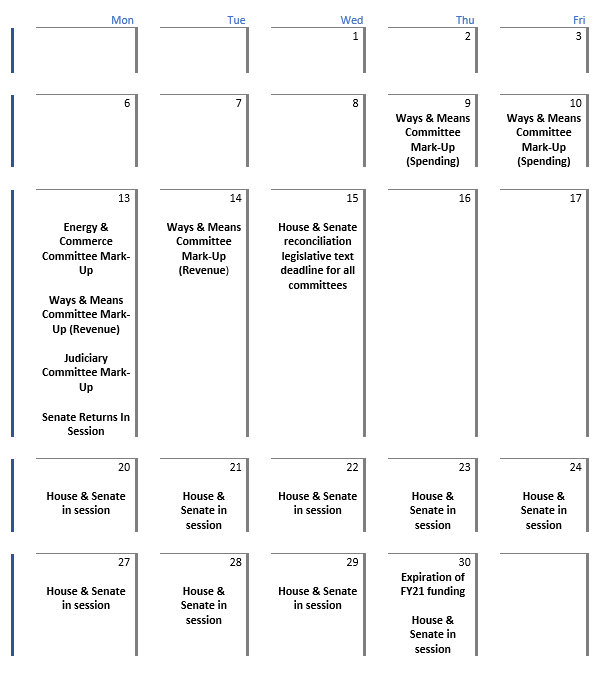
Lawmakers are facing a September like no other.  With only a dozen or days scheduled to be in person in DC, Members of Congress must address a $3.5 trillion “human infrastructure” package, a $1 trillion bipartisan infrastructure bill, last month’s expiration of the debt ceiling, and appropriations for Fiscal Year (FY) 2022.  Each of these major bills carries several steps of their own, including committee hearings, markups, and behind-the-scenes negotiation.  How will lawmakers on Capitol Hill make it through such a complicated month?

Calendar At-A-Glance

Here’s how the calendar sets up.

Okay, Let’s Break it Down

Reconciliation

So, the House committees are meeting to mark-up the $3.5 trillion human infrastructure bill, also known as the reconciliation bill.  Speaker Nancy Pelosi (D-CA) has expressed a desire to pass the entire reconciliation bill by October 1, punting her version over to the Senate.

But what about the Senate?  The Senate is out till September 13. Even though their version of the reconciliation bill is due September 15, the Senate has yet to schedule any committee hearings.  Remember too that the Senate committees are a 50:50 split, meaning it’s harder to pass partisan legislation like this out of committee.  This all leads us to believe that the Senate may only release concepts or principles around what will be included in the legislation to meet the deadline.

We expect that when the House passes their bill, the Senate substitute the bill with their own changes. The Senate floor process includes debate and likely another all-night vote-a-rama session.  With any changes the Senate makes to the bill, the House will have to vote again, meaning the reconciliation bill has a way to go before it reaches President Biden’s desk.

Bipartisan Infrastructure Bill

Speaker Pelosi issued a September 27 deadline for the House to vote on the bill as the Senate approved it by a 69-30 vote on August 10.  If the bill doesn’t get passed in time, the House will have to vote to extend the Highway Trust Fund, which is estimated to become insolvent by October 1.

Debt Ceiling

Oh yeah, and Congress will need to raise or suspend the debt ceiling to avoid the US from defaulting on its loans. Usually, lawmakers generally agree in a bipartisan manner to increase the debt limit, but Republicans have publicly stated they will not support raising the debt limit and could force Democrats to raise the debt limit in a partisan way and without any Republican support.

Appropriations

Even though the House has passed 9 out of 12 appropriations bills, the work has just begun in the Senate.  This signals the likelihood that Congress will need to pass a continuing resolution before September 30th to keep the government funded past September.

How Will Things Play Out?

Between a packed schedule, partisan differences in key legislation, and divisions among some Democrats, September is shaping up to be an unpredictable month for Congress.  Below are some key items to watch for.

Will the House pass the bipartisan infrastructure bill by September 27?

Speaker Pelosi announced the September 27 deadline per an agreement with a group of moderate House Democrats who didn’t want to vote on the $3.5 trillion reconciliation bill without voting on the bipartisan infrastructure bill first.  Many moderate Democrats are holding firm on this agreement to pass this bill, even if the Senate is not finished with their reconciliation bill. Therefore, the divide between moderates and progressives on how to move forward with the legislation could create more problems for the Speaker.

Will Sinema and Manchin demand a lower dollar amount for reconciliation?

However, the main question that is still on everyone’s mind is will the Democrats unanimously support $3.5 trillion in new spending as moderates in both chambers have concerns around this high price tag.

Even though Senate Democrats unanimously approved the budget resolution, two key moderate Democrats have signaled an unwillingness to approve $3.5 trillion in new spending, thus raising doubts about the bill’s future.  In a statement issued after the budget resolution’s passage, Sen. Joe Manchin (D-WV) expressed “serious concerns about the grave consequences” facing Americans if Congress decides to spend an additional $3.5 trillion.  On August 23, a spokesperson for Sen. Kyrsten Sinema (D-AZ) said the Senator would simply not back a $3.5 trillion bill. As the next couple of weeks unfold, all eyes will be on both Senators as the negotiations are ongoing around the reconciliation bill.

September Is Only the Beginning

With September as thorny as it is, Q4 is shaping up to be the biggest legislative fall in a number of years.  And just when they figure out these massive domestic policy issues, 2022 will be just around the corner, and with it a quick transition to campaign season for the midterm elections.

darren-halstead-sT50jo9LCH0-unsplash-1920x1280

Lay of the Land for 2022 Senate Elections

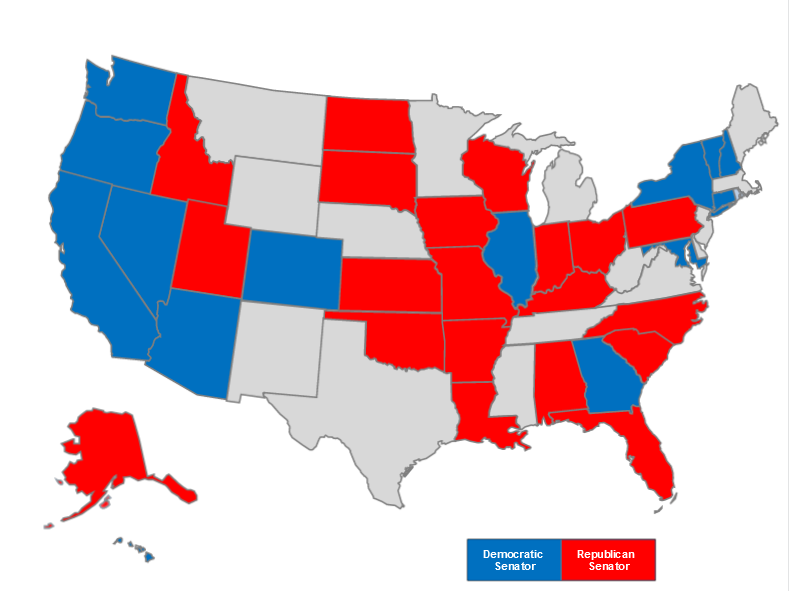
The 2022 midterm election for the US Senate is a tale of two conflicting narratives.  On the one hand, the map favors Democrats, who only must defend 14 seats compared to Republicans’ 20 seats.  On the other hand, midterm elections typically do not bode well for the party that occupies the White House, giving Republicans an advantage.  Given the current 50-50 split in the Senate, the stakes for either party couldn’t be higher.

To illustrate the current lay of the land, the map below shows all the seats up for the 2022 election along with the party of the incumbent.

The 2022 Outlook

Below is a chart of all the states with a 2022 Senate election, their likely outcome according to the Cook Political Report with Amy Walter, and a comparison with 2020 presidential election results.

State Incumbent Party Projection 2020 Presidential Margin
Alabama Richard Shelby* R Solid R Trump (+25.5)
Alaska Lisa Murkowski R Solid R Trump (+10.1)
Arizona Mark Kelly D Lean D Biden (+0.3)
Arkansas John Boozman R Solid R Trump (+27.6)
California Alex Padilla D Solid D Biden (+29.5)
Colorado Michael Bennet D Solid D Biden (+13.5)
Connecticut Richard Blumenthal D Solid D Biden (+20)
Florida Marco Rubio R Lean R Trump (+3.4)
Georgia Raphael Warnock D Lean D Biden (+0.2)
Hawaii Brian Schatz D Solid D Biden (+29.5)
Idaho Mike Crapo R Solid R Trump (+30.7)
Illinois Tammy Duckworth D Solid D Biden (+16.9)
Indiana Todd Young R Solid R Trump (+16)
Iowa Chuck Grassley R Solid R Trump (+8.2)
Kansas Jerry Moran R Solid R Trump (+14.6)
Kentucky Rand Paul R Solid R Trump (+26)
Louisiana John N. Kennedy R Solid R Trump (19.6)
Maryland Chris Van Hollen D Solid D Biden (+33.5)
Missouri Roy Blunt* R Solid R Trump (+15.4)
Nevada Catherine Cortez Masto D Lean D Biden (+2.4)
New Hampshire Maggie Hassan D Lean D Biden (+7.4)
New York Chuck Schumer D Solid D Biden (+23.1)
North Carolina Richard Burr* R Toss-up Trump (+1.3)
North Dakota John Hoeven R Solid R Trump (+33.3)
Ohio Rob Portman* R Lean R Trump (+8)
Oklahoma James Lankford R Solid R Trump (+33.1)
Oregon Ron Wyden D Solid D Biden (+16.1)
Pennsylvania Pat Toomey* R Toss-up Biden (+1.2)
South Carolina Tim Scott R Solid R Trump (+11.7)
Utah Mike Lee R Solid R Trump (+20.3)
Vermont Patrick Leahy D Solid D Biden (+35.4)
Washington Patty Murray D Solid D Biden (+19.2)
Wisconsin Ron Johnson R Toss-up Biden (+0.6)

*not seeking reelection

Democrats May Have an Advantage…

Five Republican incumbent Senators, Shelby, Blunt, Burr, Portman, and Toomey, are not seeking reelection, and three of them represent states that are currently rated as “toss-up.”  This leaves the GOP without the advantage of an incumbent candidate on the ballot for three key races.  Furthermore, the number of “toss-up” states without an incumbent GOP Senator on the ballot could grow from three to four if Sen. Ron Johnson (R-WI) decides not to seek reelection.  In contrast, none of the 14 Democratic Senators in the mix for 2022 have announced retirement plans.

Democrats are also heading into the 2022 Senate races with an impressive war chest.  During the second quarter of 2021, several Democratic candidates in competitive states announced sizable fundraising totals, including Sen. Raphael Warnock (D-GA) with $7 million and Sen. Mike Kelly (D-AZ) with nearly $6 million.  The strong fundraising shown thus far is reminiscent of the 2018 and 2020 cycles, where Democrats translated money raised into electoral victories.

…Or Not

However, there are many other factors to consider, namely the popularity of President Joe Biden.  As mentioned before, midterm elections tend to not favor the party that controls the presidency, and an unpopular president has the potential to hurt Democrats even more.  Recent polling shows that President Biden’s approval rating has dipped below 50% as the Delta variant, inflation, and the evacuation of Afghanistan take a toll on Biden’s agenda.  If these trends persist into 2022, Democrats might find themselves in a tough position to win any “toss-up” seats.

Trump: the X Factor

A major unknown factor heading into the 2022 Senate races is the role of former President Donald Trump.  Since leaving office, Trump has continued to hold rallies with his supporters and endorsed candidates who he perceives as loyal to him.  In June, for instance, Trump endorsed Rep. Ted Budd (R-NC) in the GOP primary to succeed the retiring Sen. Richard Burr (R-NC) in the race for North Carolina’s open Senate seat.  This endorsement conflicts with Sen. Rick Scott (R-FL), Chairman of the National Republican Senatorial Committee, who has expressed a desire for the former president to refrain from endorsing candidates until the primaries have wrapped up.

While it remains uncertain how much influence Trump will have over Senate races, the former president’s influence over recent House special elections offers clues.  In a July 27 special election for the 6th Congressional District of Texas, Republican State Rep. Jake Ellzey defeated the Trump-backed candidate Susan Wright in a runoff race to succeed Wright’s late husband, Rep. Ron Wright (R-TX).  However, a Trump endorsement may have been helpful to Republican Mike Carey, who won the Republican primary for a special election on August 3 to fill a seat representing the 15th Congressional District of Ohio.  The seat, which was vacated with the retirement of Rep. Steve Stivers (R-OH), leans Republican, meaning Carey is highly favored to win the general election on November 2, 2021.  Trump’s mixed record on special elections in 2021 further indicates the continued uncertainty on his sway over the Senate races next year.

Uncertain Impact of 2018 Midterm Elections

With the 2022 midterm elections on the horizon, it remains unclear whether the trends from the 2018 midterm elections will carry over into next year, especially for the Senate.  While the 2018 midterm elections saw the highest turnout in over half a century, the results were split between both parties.  While Democrats gained a total of 39 seats in the House, Republicans were able to gain two Senate seats, partially defying a trend that typically sees the party which occupies the White House lose seats in Congress.  However, the 2018 Senate map was historically bad for Democrats, and Republicans face a similar situation heading into 2022.  That said, with a new president and new issues currently dominating the public discourse, 2022 presents a different landscape from 2018, making it difficult to draw any hard conclusions from the previous midterm elections.

element5-digital-T9CXBZLUvic-unsplash-1920x1280

Subscribe to Us Now!

Be a DC insider by getting our updates straight to your inbox